


Understanding the Problem First
Flooring issues are frustrating, and not every problem has a simple repair. Our Flooring Repair Evaluations are designed to determine whether your floor can be repaired or whether replacement is the smarter long-term solution. We start by identifying the root cause of the issue, not just the visible symptom. In many cases, what looks like a surface problem is actually related to subfloor conditions, moisture, or the original installation. Our goal is to give you a clear, honest assessment so you can make the right decision without spending money twice.
Common Repairable Flooring Issues.
A few common issues we see that typically ARE REPAIRABLE:
Repair Type | When It Makes Sense |
|---|---|
Multiple hardwood scratches / wear | Floor is structurally sound and wear is limited to the surface finish |
Localized hardwood board damage | Matching material is available and damage is isolated |
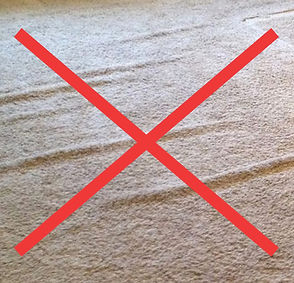
Creased or bubbled carpet | Carpet is in good condition and issue is installation-related (restretching) |


Flooring Issues That Appear Repairable, But Often Aren't
Some flooring problems appear to be isolated or cosmetic, but are often symptoms of underlying conditions that repairs cannot correct. The table below outlines common issues by flooring type that frequently require more than a surface-level fix.
Flooring Type | Issue Observed |
|---|---|
Carpet | Matting or crushing |
Carpet | Worn traffic lanes |
Carpet | Fraying edges |
Tile | Repeated cracking in same area |
Tile | Loose or popping tiles |
Tile | Cracked tiles |
Laminate | Soft or spongy areas |
Laminate | Peaking or edge lift |
Laminate | Bubbling or swelling |
LVP / Vinyl Plank | Uneven, wavy, or sloped areas |
LVP / Vinyl Plank | Gaps opening between planks |
LVP / Vinyl Plank | Cracked or splitting planks |
When Repair Is No Longer the Best Long-Term Solution
Age, wear, and material limitations often determine whether repairs will hold. Sometimes in these situations, replacement is the more reliable investment.
Flooring Type | When Repair is Less Effective |
|---|---|
Carpet | After fiber breakdown, matting, or widespread wear |
Tile | When cracking or movement repeats due to subfloor conditions |
Laminate | After moisture exposure or once the core has deteriorated |
LVP / Vinyl Plank | When issues appear after several years or across multiple areas |
Hardwood | When wear extends beyond the finish or boards are no longer structurally sound |


Our On-Site Evaluation Process
-
Schedule your evaluation — we'll review the issue firsthand to understand whats happening with your floor
-
Assess conditions & root cause — We evaluate the visible issue and underlying conditions.
-
Determine the right solution — We determine whether the issue can be corrected with a true repair or whether replacement is the more reliable long-term solution.
-
Review options & pricing — If replacement is recommended, we review appropriate materials (LVP, carpet, tile, hardwood and more) and provide clear pricing covering materials, prep, labor and timelines.
-
Schedule the work — Once the solution is confirmed, we schedule the project.
Why “Spot Repairs” Are Rarely Simple
Many flooring repairs are referred to as “spot repairs,” but with modern flooring systems, accessing a damaged area often requires removing surrounding material.
With floating floors such as LVP and laminate, planks are typically installed as a locked system. To reach a damaged plank in the middle of a room, surrounding planks must often be removed and reinstalled in sequence. This process can involve taking up a significant portion of the floor, not just the visibly damaged area.
Hardwood flooring can present similar challenges. Depending on the installation method and layout, replacing individual boards may require cutting into adjacent boards, removing sections of the floor, and blending new material into existing areas.
Because of this, what appears to be a small repair can quickly become invasive. This is why spot repairs are highly dependent on layout, access points, material availability, and underlying conditions, and why they can’t be accurately quoted or guaranteed without an in-home evaluation.
Our role is to determine whether a spot repair can be completed properly or whether replacement is the more reliable solution.
![IPIDhtlW-860x493-1[1].jpeg](https://static.wixstatic.com/media/c49cb0_bcae30007dae416587b7da8968bd52af~mv2.jpeg/v1/fill/w_294,h_169,al_c,q_80,usm_0.66_1.00_0.01,enc_avif,quality_auto/c49cb0_bcae30007dae416587b7da8968bd52af~mv2.jpeg)
Flooring Repair Evaluations For:
Areas We Service In Pennsylvania:
Bucks County
-
Bensalem
-
Bristol
-
Doylestown
-
Chalfont
-
Croydon
-
Fairless Hills
-
Feasterville-Trevose
-
Langhorne
-
Levittown
-
New Hope
-
Southampton
-
Warminster
-
Warrington
-
Washington Crossing
Montgomery County
-
Abington
-
Ambler
-
Blue Bell
-
Bala Cynwood
-
Conshohocken
-
Horsham
-
King or Prussia
-
Lansdale
-
North Wales
-
Plymouth Meeting
-
Skippack
-
Souderton
-
Willow Grove
-
Wynnewood
Philadelphia
-
Center City
-
South Philadelphia
-
Southwest Philadelphia
-
West Philadelphia
-
Roxborough
-
Manayunk
-
Germantown
-
Chestnut Hill
-
North Philadelphia
-
Northeast Philadelphia
-
Far Northeast Philadelphia
Areas We Service In New Jersey:
Burlington County
-
Burlington
-
Chesterfield
-
Cinnaminson
-
Evesham
-
Maple Shade
-
Moorestown
-
Mount Holly
-
Mount Laurel
-
Palmyra
-
Southampton
-
Springfield
-
Washington Township
-
Woodland Township
-
Wrightstown
Gloucester County
-
Auburn
-
Bridgeport
-
Clayton
-
Cross Keys
-
Horsham
-
Deptford
-
Ewan
-
Franklinville
-
Glassboro
-
Harrison Township
-
Logan Township
-
Mullica Hill
-
Sewell
Camden County
-
Cherry Hill
-
Haddonfield
-
Haddon Heights
-
Voorhees
-
Berlin Borough
-
Stratford
-
Collingswood
-
Audubon
-
Barrington
-
Merchantville
-
Laurel Springs
-
Oaklyn
-
Gibbsboro